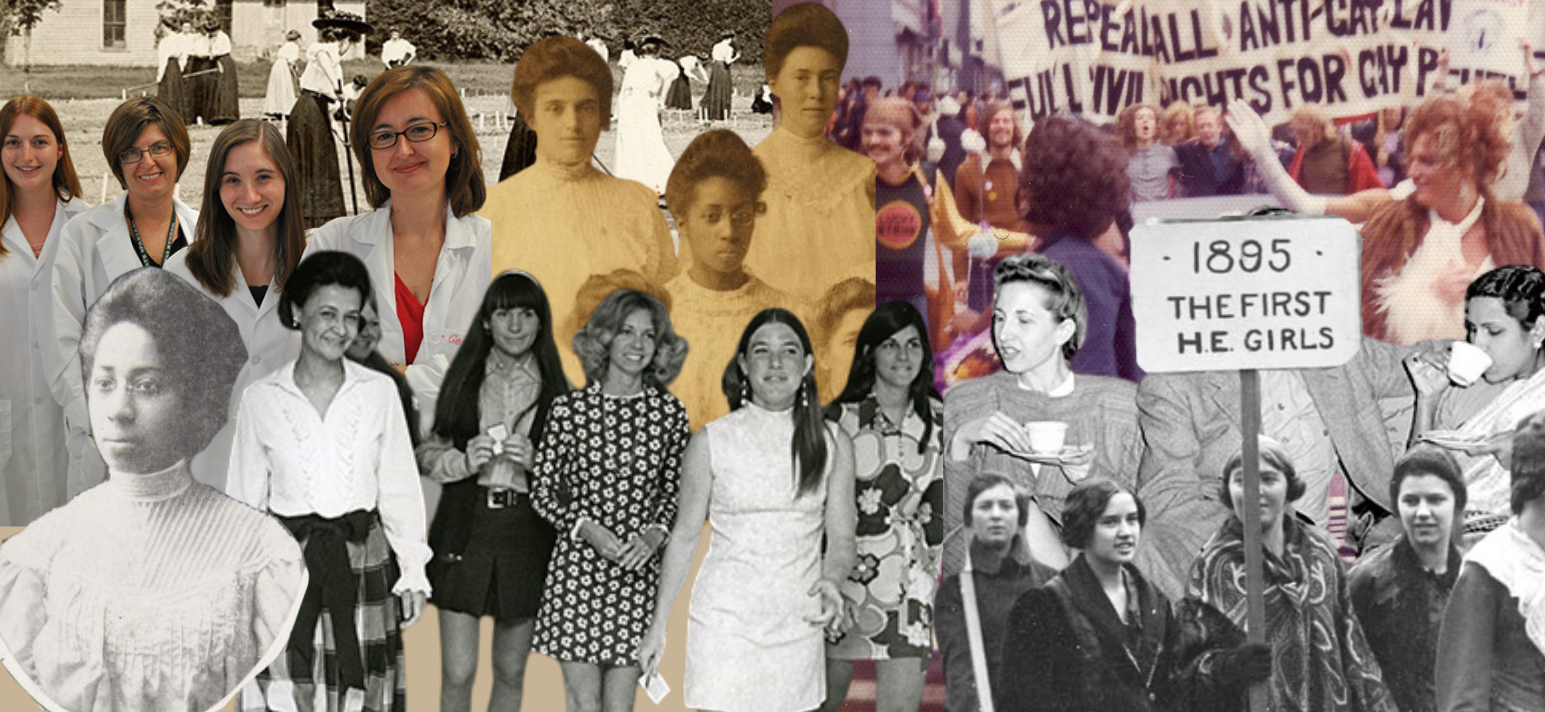
During the 2025-2026 academic year, Dr. Lisa Fine, a professor in the Department of History, taught a class during the fall and spring semesters that was unique from typical seminar courses. The course, “Documenting the History of Women’s and Gender Studies at MSU” offered as WS491 in the fall and continuing as HST480 in the spring, was a year-long research endeavor focused on discovering and documenting the history of Women’s and Gender Studies programs at Michigan State University. The course began with laying a foundation of knowledge regarding historical research, a history of higher education, mid-to-late 20th century American women’s history and a history of the development of WGS programs at other universities. Since no comprehensive history of WGS programs at MSU has been conducted before, once the course’s research component began Fine and her students participated in conducting this research together, with students being equal collaborators on the overall project.
“In the last few years, I became aware of the fact that the field of women’s studies, gender studies, was being challenged in a lot of different places for lots of different reasons. I also became aware of some of the people that I knew about or even had the privilege to meet early on were passing away,” Fine said. “I thought it would be so important to document and to chronicle and to sort of create for posterity the history of women and gender studies at Michigan State.”
Fine came to MSU in 1985 as a labor historian and, from the beginning of her career at the university, she was involved in women’s studies. Fine was the co-director of GenCen from 2007 to 2016 and is currently a GenCen fellow, a position that has allowed her to teach a women’s studies course this year. She emphasized that a major goal in these courses was to have the documenting of MSU WGS history be a fully collaborative project among her and the students.
“This is a thousand percent richer and more varied and more inclusive than anything that I could have done on my own,” Fine said. “And hopefully the students can recognize the importance of that kind of collective, that sometimes that is a very fruitful way to proceed. It doesn’t have to be for every task, but for something like this, sometimes pooling our resources and our brains can come up with something really, really wonderful. And the process of it is [more] interesting sometimes and [more] challenging and satisfying and maddening than the product itself.”
Students could take the course in either the fall or spring semester or both, with every student and Fine being credited as collaborators on the overall project. Students were invited to pursue specific facets of the research that they were interested in and to work with others in the class interested in similar topics.
“A big thing with my own values is that I’ve always wanted to do work that highlights voices or stories that are maybe not as visible as before, not part of the mainstream, and then seeing what we can learn from those stories,” said Saumya Johri, a third-year undergraduate student studying social relations and policy. “If you don’t bring these stories to the forefront, you risk repeating things, just more harm being done. And I think that, especially with MSU’s story, given what we’ve uncovered, the ebbs and the flows and where we’re at right now, I think it offers a lot to just learn about what has happened, where we are, and then where we can go next.”
Johri was enrolled in the first semester of the course and then took the second semester as an independent study. She was particularly interested in student activism, interactions with administration, and uncovering intersectional voices and experiences that are often overlooked. Johri compiled her research by combing through past State News issues and frequently visiting MSU Special Collections and University Archives.
“Something that I have found very profound about women’s studies through this course is the fact that it’s not limited to the confines of the classroom. So many of the faculty, the staff, they are involved with activism on campus and generally just making it safer, promoting equity,” Johri said. “I think in comparison, if you compare [other] classes to what we’re doing here, I feel like those classes feel a little more confined. Like you leave the classroom and you’re like, ‘okay, now I gotta move onto the next set and try to think of something profound for that.’ I feel like a lot of what we’re doing here is very ongoing and building on a lot of previous insights I’ve had.”
A major goal of this project was to document the history of WGS programs at MSU and to make this information and these sources easily available and accessible for future researchers and the public. Part of the compilation of the course’s final project was creating a website presenting the classes’ findings and providing a platform to view primary documents, audio recordings, and other archival materials that had been previously more difficult to locate.
“Documenting was the first word,” Fine said. “Just preserving those voices, preserving those stories for MSU and beyond I think is really important.”
Liz Koempel, a transfer student studying information science and arts and humanities, worked primarily on organizing and constructing the website alongside a couple other students in the course. She made regular trips to MSU LEADR, the Lab for Education and Digital Research housed in the Old Horticulture building with the history department, learning to use both the website creation software and the audio recorders to conduct oral histories.
“I think it’s super important to be documenting women’s history in general, especially in more specific contexts,” Koempel said. “This is important because every other history class is about men. And even if it’s gender neutral, even if things are gender neutralized, it’s still kind of from a male’s perspective and about men, somehow, it seems. And I think that a lot of things that women do are essentially lost to history.”
Fine and her students agreed that documenting this history was not only valuable to women’s history and MSU history in general, but to understanding the importance and legacy of WGS programs for universities. MSU’s WGS program in particular is unique to many other universities in the United States, since it has never had its own department. The reason for that difference is one of the many questions Fine and her students were hoping to uncover over the course of the year.
“There is a massive disconnect between the expertise and the number of faculty who saw themselves as women and gender scholars from the very beginning,” Fine said. “There were so many, even in the ‘70s, there were so many women and gender scholars, in so many fields. All across campus. And not just in the fields that you traditionally think that they would be in, you know like the humanities and the like, but they were all over campus and it’s almost, the historical question is not, ‘why couldn’t they get enough scholars to make a women’s studies program?’ which is the one you think is more common, it’s, ‘out of all these women’s studies scholars, why wasn’t this one of the powerhouses on campus?’”
Fine will continue to work on this project after the course ends, with the research culminating into a book on the history of WGS at MSU. All students that have worked on the project with Fine in either course or continuing as research assistants into the next academic year will be credited as collaborators on the project.
“I wanted [students] to become aware of what it was like to do what we do. That there are blind alleys and that there are hypotheses that we can’t necessarily answer,” Fine said. “And then of course making the case for the important knowledge creation that women’s studies scholars individually and the field collectively have contributed over the years. [...] And so hopefully that in of itself helps to make the case, that it’s a field, it’s a discipline, it’s a body of knowledge, it’s a practice, it’s a pedagogy, [...] [and] we take so many of those things for granted, in the way that we do our work and that needs to be recognized too.”
These courses were available to upper-level undergraduate and graduate students, and they fulfilled seminar credit for women’s and gender studies and history in the fall and spring, respectively.

Academic Programs
Learn more about our undergraduate majors and minors

Faculty & Staff Funding
Explore our Strategic Partnership Grants and other funding resources
Study Abroad
Learn more about our study abroad programs in London and Malawi

Upcoming Events
Engage with global gender and sexuality scholars through our events