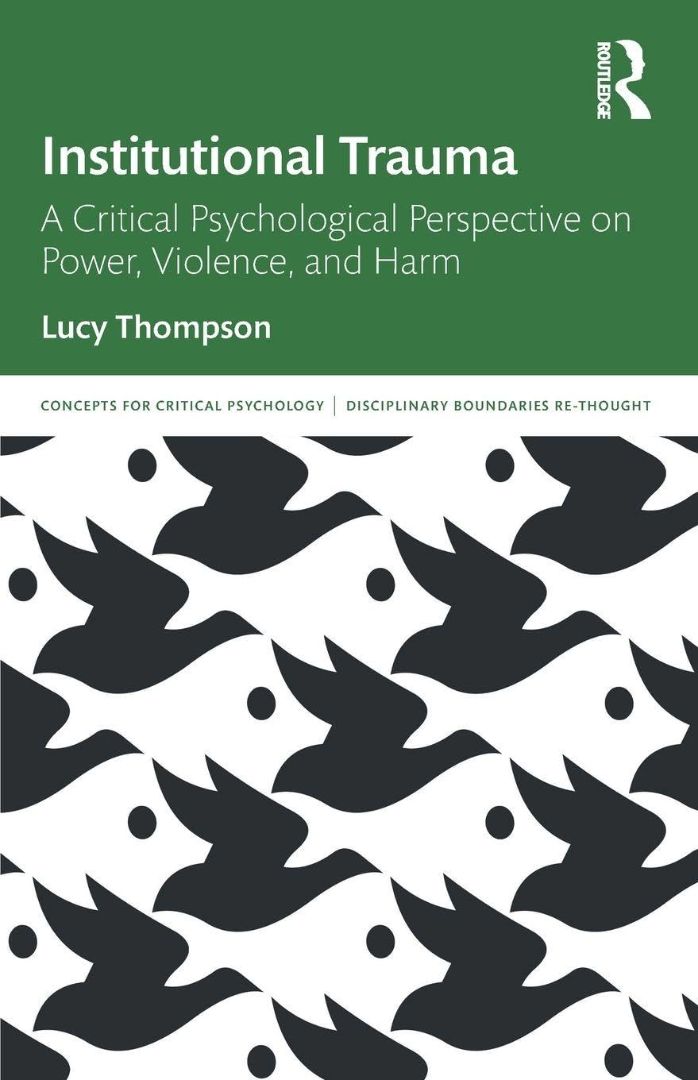
The Center for Gender in Global Context is honored to showcase the work of our affiliated faculty member Dr. Lucy Thompson and her recently published book, Institutional Trauma. The book provides a critical look at how mainstream psychology views, studies, and treats trauma. Using a feminist framework that accounts for the personal as fundamentally political, she critically explores how trauma knowledge is shaped by politics, colonialist histories, and capitalism, and – most importantly – she examines its role in shaping institutions. She argues against the individualized medical model of trauma that places responsibility on individuals to heal and overcome trauma, as well as the orientation of the field of academic psychology as a supposedly objective arbiter of what counts as trauma. By publishing this book, Thompson hopes to expand the field’s current understanding of trauma as an institutional phenomenon that must be addressed through an intersectional and systematic lens.
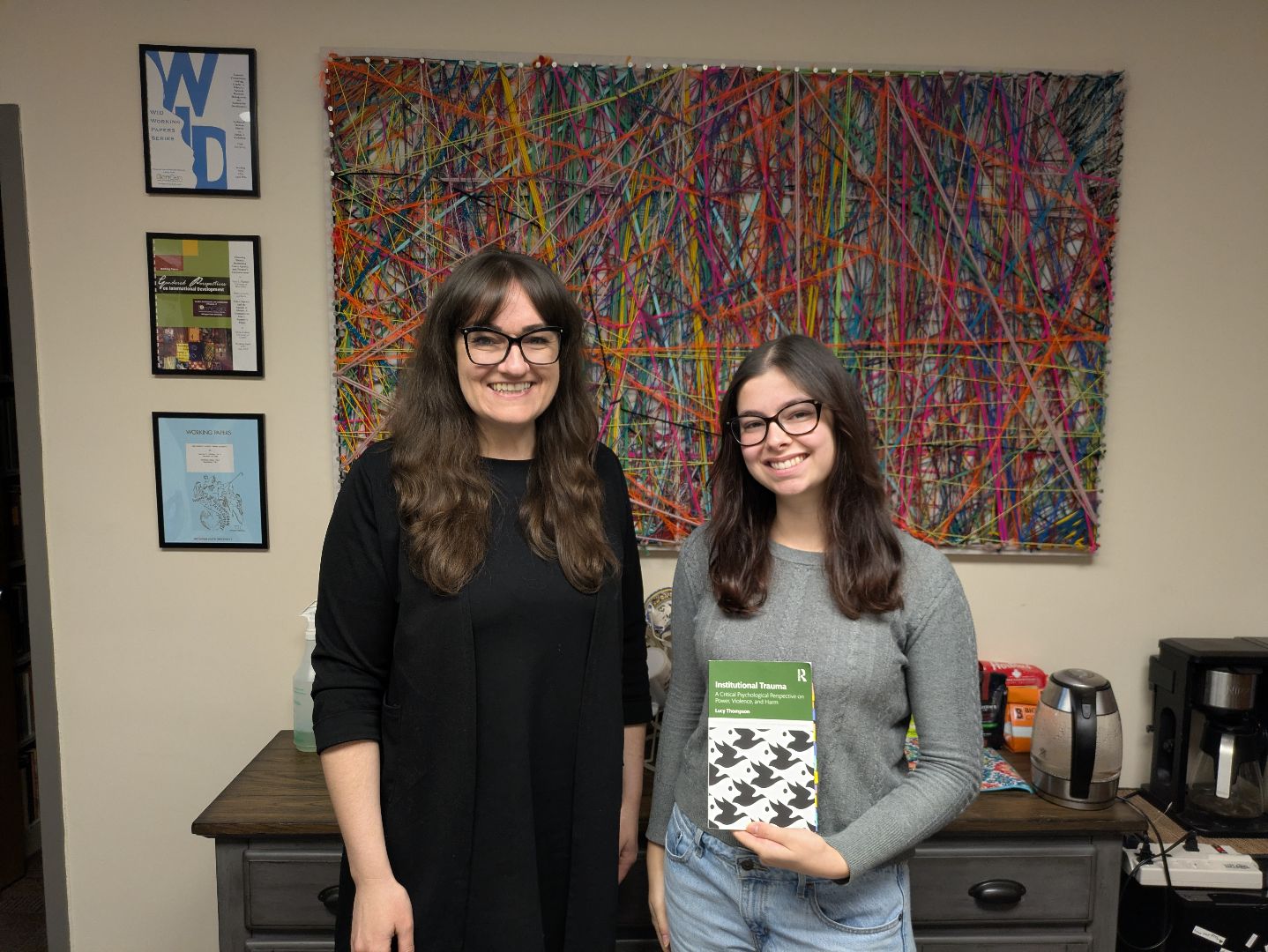
In Spring 2026, GenCen sponsored a book club with faculty, staff, and students reading the book together. Nicole Becker - ‘26 MSU graduate in psychology and Women’s and Gender Studies, GenCen research assistant, and book club leader – was able to sit down with Lucy for an extended interview:
Nicole: Thank you so much for meeting with me today. I really enjoyed reading the book, and I enjoyed taking your class [Psychology of Women], of course. That course led me to where I am now and where I am going in my career and future studies in feminist psychology. What is the impact that you are hoping Institutional Trauma has on individual readers as well as the field of psychology as a whole?
Lucy: That’s a big question. One of the greatest things about doing this book is kind of getting to see where it goes in the world and how it impacts people in different ways, and so I’m excited to know that too. I just don’t know yet. I think for me the core personal outcome or impact I’m hoping for maybe is that people could see themselves and their experiences in what I’ve written and maybe this adds some layer of language to those kinds of personal experiences to try to name things that aren’t named or that remain silent within a look of institutional contexts. I’ve already had some people contact me about that and say that they needed the book to be able to work through some of their experiences that they just couldn’t put words to. I think that really ties into that broader idea of hermeneutical justice and thinking about languages that are missing for particular experiences and that really foreclose our ability to even try to understand them. Part of the contribution is this idea that trauma knowledge has been very limited and that is an institutional consequence of knowledge production in the social sciences and psychology. So, this is part of that effort to expand knowledge around trauma and create or contribute to a newer language about that that maybe people can see themselves in. More broadly institutionally, I think for me this book is about is about trying to start conversations about institutional relations and power, and I hope that more projects can come out of this applying this in lots and lots of different domains, institution contexts and also academic domains and frameworks and perspectives that would allow us to apply this framework to understand the institutional specificities of particular experiences in particular times and places from particular perspectives. Different organizations, for example, and also more broadly in terms of other critical disciplines or perspectives. So, we have right now a group who are working with this book as part of their work with incarcerated women to think about institutional trauma in that context and so now it’s starting to be taken out and put into different spaces. And then there is a lot of work to be done around disability justice, that kind of thing. But really, what I wanted to do with this book, because you can’t do everything, is really do the grain of the idea from this critical feminist and psychological perspective that could then be applied all over the place in lots of different ways.
Nicole: That’s great. So, as part of this book you criticize the responsibility and blame that is placed on survivors to heal through individualized treatment. What should psychiatrists do with this information? Do you think it’s helpful for them to address institutional power and trauma with their patients directly?
Lucy: Yes, I do. I think the goal of the book in terms of trying to broaden out the conversation is to add to what has been done, but it also makes the case that we need to understand the limitations of that singular approach to really placing the responsibility on individuals. The book is kind of a two part in that sense that we have to understand the limitations of those kinds of claims and what they do to people, like what kind of responses they invite or what kind of treatment they warrant. That’s kind of one part of the book, really interrogating that very singular and narrow individualized response, where it comes from, what kind of solutions it proposes and then how people are then enrolled or enlisted into pursuing those solutions. That highly neoliberal and that kind of realm of trauma capitalism has been the dominant way of really understanding and responding to survivors. And that has consequences. It can be helpful in some ways in the sense that it is good to be able to share your experiences with somebody and for them to offer you advice, but when that directs people down this very narrow pathway and closes off other modes of knowing and other modes of understanding, we have an incomplete picture. So, my perspective on this is that there should be a broad range of ways to come to terms with what happens. I talk specifically about sexual assault survivors; that’s not something that a lot of people really want to truly address because it is deemed to be too complex, so we get this kind of individual response. Being sincerely interested in understanding the broader conditions and really how instrumental those are in people’s experiences is really necessary. I think mapping institutional relations and doing institutional consciousness raising - it may not even have to be with psychiatrists. The jump to sending people to a psychiatrist is also part of that problem. There are other ways with community and things like that that we can respond to this that aren’t within medical spheres that could be incredibly liberating for people.
Nicole: You already started to answer this, but what should those in the field of psychology do with this information? Where should they go from here, especially if they were not familiar with feminist methods or broader forms of research than traditional psychology before reading the book?
Lucy: Well, I’m not very good at telling people what they should. I think people will get out of this book whatever they get out of it. Wherever that takes them is great. For people that want to learn more about feminist psychology, learn about the history of feminist psychology. It’s really a shame that feminist psychology is so absent within broader departments and undergraduate education and those spaces. Even when we have courses on the psychology of women, that’s different from feminist psychology. We’re not teaching, necessarily, feminist psychology as a discipline. So, there needs to be more education around feminist psychology as a discipline, as a kind of a space that deconstructs mainstream psychology in really powerful ways and provides a counter narrative of psychological knowledge. I would say to students, demand more feminist psychology in the curriculum. Departments should be open to broadening their curriculum. Right now, feminist psychology and actually the psychology of women are king of siloed. Psychology of women is more visible but still remains siloed in the sense that the topics that we talk about in psych of women are topics that really are of concern to everyone, to all psychologists. They should be integrated into all sorts of different courses, but they are kind of just shoved to the side into psychology of women, women’s issues, when actually they’re kind of relevant to everyone, and so I would say that some kind of attention to how that’s taught would be great to make it more accessible to students. I also think just more knowledge about where the feminist psychologists are is useful. There’s not very many departments in the United States who have feminist psychologists, but CUNY has Professor Michelle Fine who is a community psychologist working from a feminist psych perspective. The department I’m going to has some feminist psychologists, but I think feminist psych courses would be a fantastic way to share that knowledge. You can’t really expect people to go and learn about this without providing places where they can learn about it. It should be a collaborative effort. There’s also a really great website called psychology’s feminist voices where people can go to learn about a ton of feminist psychologists, so I like to shout out to them every time I can.
Nicole: What would you say to someone like me that’s trying to incorporate feminist theories and methods into my psychology work, and for any undergraduate students that are currently planning on seeking higher education and working in the field of psychology that would like to utilize feminist methods in research, do you recommend that they stay within this field or pivot to another field, like Women’s and Gender Studies, that may already have space for this lens and allow for it with less criticism?
Lucy: This is such a great question. Firstly, what I would say to you is good job, thank you for doing it because feminist psychology as a discipline needs feminist psychologists to sustain it. Doing what you’re doing is pivotal to that. The other part of the question…there’s a debate about this; it’s a lost-standing debate. So, I'll address it later, but one thing I would say is find the feminist psychologists early. Go to, for example, like division 35 events of the American Psychological Association; that’s the section for women and gender and psychology of women. I think they are trying to change their name to the intersectional feminist section, which we've been trying forever to do that; it’s a long story about why we can’t do that. But I would say find the feminists who are in psychology as early as you can - I mean we’re doing it right now - and they’ll connect you with other feminists in psychology. It’s a very tight knit world. Having those people is really fundamental to sticking at what you're doing and not losing faith. You’ve picked up on the fact that this is a struggle. It’s really challenging. In terms of whether we should stay or leave the discipline, lots of feminist psychologists end up in other disciplines. Lots of feminist psychologists, for example, end up in education departments, in business schools - the ones who are working on organizational psych end up in business schools. So, it’s really normal for feminist psychologists to have to go somewhere else, and it depends on how pragmatic or how stubborn you want to be as to whether you stay or go. So, if you're pragmatic and you just want to kind of get on with it and find your place, there’s women and gender studies, those kinds of places. There’s a really great program at U of M, which is psychology and Women’s and Gender Studies doctoral program, which combines the two. It’s very unusual, and so I always direct people to look at that program because it’s one of the only ones we see in the US. It’s rarer to have people staying in psych departments. Those of us who do are determined to have a place in psychology and determined to say actual feminist psychology needs to survive, that includes me. I refuse to leave psychology; I think it’s important that we stay. Doctor Sarah Mclachlan at University of Michigan, Michelle Fine at City University of New York, they’re two other examples of feminist psychologists who have stayed in psychology. There are others as well. But it is an interesting question, and I think that my answer is really based around how determined you are to hold space for feminist psychology and take that on as a mission, and that’s something that I’ve consciously and intentionally decided to do. So, the goal is really to find the places where there are people doing that. Deakin University has a phenomenal psychology department where there are some feminist psychologists, and then the department that I’m going to at the University of West Georgia also has a critical psychology focus. They’re two of the only departments in the US that do that stuff.
Nicole: Why do you personally feel that you want to stay in psychology and kind of maintain a feminist perspective?
Lucy: That’s who I am through and through. As an undergraduate student, I trained as a feminist psychologist without really knowing it because I was in a department where there were feminist psychologists. That just so happens to be where I was. I did intentionally take that program because it was an applied psychology program which kind of indicated to be already that there was going to be more of an applied dimension to it, but once I realized how important feminist psychology was as an enduring counter-narrative to mainstream psychology, and once I realized that that was really the only discipline I saw myself in, I was completely committed to that discipline. So, one of the problems for me was that when I was going through my undergrad, I couldn’t see myself in these theories. All of the theories I was coming across as an undergrad student in psychology - the mainstream theories - according to those theories, I should have been basically a complete delinquent. Like, I was basically seeing my experiences being pathologized because I don’t fit the norm of the privileged subject that psychology idealizes. I mean anyone who’s not a privileged man doesn’t really fit that in the first place, and there are layers to that. So, I just thought we have to have a discipline where people can see themselves and also that scrutinizes this fundamental bias of mainstream psychology that others and alienates everyone else in relation to this male is norm standard. There are all sorts of other norms and standards as well involved in that. So, it was imperative that I had to do this. I think that in order to make sure that other folks don’t have to go through that same process and then find nothing, we need to maintain and keep the discipline alive. I owe everything I have now to the discipline of feminist psychology and the network of peers and feminist psychologists who have supported me and I view it as my responsibility to pass that on to the future generation of feminist psychologists as well. It’s really important.
Nicole: So, you just wrote this book and you got a new job - congratulations - so, what does this say about the future direction of your research in this field, where does this give you the groundwork to go, and in general, what’s next for you in your career?
Lucy: It’s really exciting. So, the department that I’m moving to has a specific focus on the psychological humanities, as opposed to the psychological sciences, which is 99.999% of most psychology departments in the U.S. So, it’s really exciting to be going to a space where a different perspective on psychology is welcomed and valued. With that, it means that I’ll be working with people who share similar perspectives, who have worked on similar projects to me and topics. There is a lot of overlap with qualitative research; a lot of qualitative research is in that department doing really creative work. Because it’s a tenure track position - and this is a whole other layer of the politics of academia - but because it’s a tenure track position, I actually have support for research and scholarship, and what I’m doing will be counted finally, and value, which is not the case in my current position. So, I really see getting the book done as an accomplishment in spite of my circumstances, rather than because of, and so I’m really excited to go into a situation where I’ll be supported to do that kind of work and that that will be valued. The possibilities that that opens up really are this support for research, time to do research, and so I’m really excited to start doing some research applying the framework from the book in lots of different ways, like institutional research. Then, specifically, I’m going to be working on a couple of different resource websites for a couple of different parts of my work, one for institutional trauma - there’s going to be a website for that - and then one for a method paper that I wrote a few years ago that a lot of people are now starting to use, which really is, again, about the personal being political. So, we’re going to be putting together a resource website for that. A lot new, more applied research-based content is going to be coming soon; that’s what I’m really excited to do. Trying to get funding to do work with communities by communities is going to be my number one concern.
Nicole: That’s very exciting. Thank you so much for sharing all of this, and, again, I really enjoyed reading your book. I can’t wait to follow your career and see what you do next.
If you are interested in reading the book, you can purchase it through the publisher Routledge or access it through MSU Libraries.

Academic Programs
Learn more about our undergraduate majors and minors

Faculty & Staff Funding
Explore our Strategic Partnership Grants and other funding resources

Study Abroad
Learn more about our study abroad programs in London and Malawi

Upcoming Events
Engage with global gender and sexuality scholars through our events